
For the next couple of weeks, I’ll be sharing some highlights from the Tucson Festival of Books I attended on March 15-16.
The first lecture I attended was titled “The Metals Powering Our World.” It featured authors Vince Beiser and Ernest Scheyder, who sat down with geologist Carmie Garzione to discuss the complexities and unintended consequences of finding and mining the minerals essential for our transition to greener and cleaner energy.
The lecture began when the moderator asked the authors why they wrote their books. Vince Beiser explained that he became interested in researching the origins of the materials used to build his electric car. Ernest Scheyder shared his experience as a Reuters journalist, stating that he had been sent to North Dakota to cover fracking, where his rent was significantly higher than what he had previously paid in New York. After two years of covering this topic, he transitioned to researching the Green Energy movement.
Key takeaways:
-Mining is a global concern that primarily impacts people negatively.
-The U.S. only has two copper smelters, while China has numerous facilities.
-The U.S. has no nickel, cobalt, or rare earth refineries, while China has many.
-The reliance of the U.S. on China for various stages of mining processes is a significant issue.
-Canada is the largest supplier of metals to the U.S., making the whole tariff thing crazy.
-Most new cars sold in China and Norway are electric vehicles.
-Producing a car (especially an electric one) involves an incredibly complex system.
-More solar panels are installed in China than in the U.S.
-The U.S. is falling behind in the green energy revolution.
-Unfortunately, we need to be more open to mining in the U.S. (I don’t necessarily agree with this statement, but I understand the sentiment.)
-There are better and safer ways to mine, but they are more expensive.
-The IRMA Standard for Responsible Mining outlines best practices for responsible mining at an industrial scale. It provides expectations that independent auditors will use as benchmarks for responsible mines.
-We have to get better at recycling in the U.S. Many (if not all?) rare earth materials never go bad.
I really enjoyed listening to these conversations and was particularly touched when Vince Beiser mentioned that he currently lives in Vancouver, Canada. Someone in the audience shouted, “We love you, Canada!” to which the author said, “Well, Canada loves America, too.” The crowd cheered, reminding us of the strange timeline we’re all living in, where we find ourselves applauding and nearly crying at such moments.
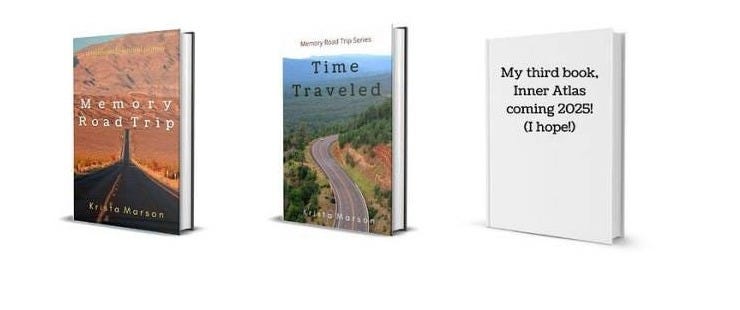
My books Memory Road Trip (e-book or paperback) and Time Traveled (e-book or paperback) are both available! You can also find them at most major international book sites.
 Krista Marson
The overwhelming (by which I mean something on the order of 95-98%) majority of US citizens simply have no idea what any of this is about. There is virtually nothing, ever, in the media about this topic and when there is it is rarely highlighted in any way to capture attention. The best anyone knows about it might be the rarity of copper, a subject that is bandied about occasionally as a joke.
LikeLike
okay, well here’s an opportunity for some people to learn.
LikeLike