
Here’s another installment from my Tucson Festival of Books series.
This was a surprisingly fun lecture where I learned a lot of interesting things about the natural world.
Author Theodore H. Fleming explored the nuances of nectar-feeding bats and birds, while author Neil Shubin shared insights about being a researcher at the planet’s poles.
As a polar paleontologist, Neil Shubin described his discovery of Tiktaalik roseae, a 375-million-year-old fossil that serves as a missing link between sea and land animals.
He also described how other researchers drilled 2.5 miles into Antarctica’s ice and discovered a freshwater lake teeming with life that was not exposed to the sun.
Seriously, this was some mind-blowing stuff to learn about.
Here are some interesting facts I learned:
— Cardon cacti, which are native to the Sonoran Desert, have a unique reproductive adaptation that involves three sexes: male, female, and a type known as “gynodioecious,” which can produce both functional male and female structures.
— The drug Ozempic is derived from the venom of a Gila monster.
— Birds are already at their maximum threshold for surviving rising temperatures and may become one of the most affected groups due to climate change.
— Neil Shubin stated that if he were dropped at one of the poles blindfolded, he could identify which one it was just by feeling the environment. The Arctic is wet and cold, while the Antarctic is dry and cold. He expresses a preference for Antarctica over the North Pole.
— The airport at McMurdo Station has to be relocated further inland due to melting conditions.
— Bats in Arizona have recently been found to be affected by White Nose Syndrome, a disease typically associated with species found in wetter conditions.
— Killer whales have become the number one predator species in the Arctic, surpassing polar bears, and they are significantly reducing the narwhal population through hunting.
— During his years of polar research, Neil Shubin has appreciated the advancements in technology, such as GPS and tools that allow scientists to examine the interiors of rocks. However, he regrets that his students now spend their free time on their phones instead of enjoying the experience of being in one of the most remote locations on Earth.
This was my final lecture of the festival, and I’m already excited to attend again next year!
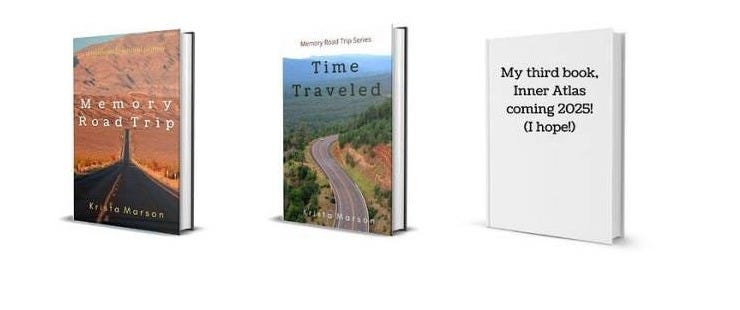
My books Memory Road Trip (e-book, paperback, audio) and Time Traveled (e-book, paperback, audio) are both available! You can also find them at most major international book sites.
 Krista Marson