
A champion of individualism and a prescient critic of the countervailing pressures of society.
Attacked materialism, opportunism, complacency, parochialism, and conformity.
Emerson : “Nothing is at last sacred but the integrity of your own mind.”
Emerson believed intuition should have precedence over intellect. TRUST THYSELF.
Emerson: using common sense, a love of nature, and his own particular genius, he expressed a higher truth about who we are and how the world gives us exactly what we demand from it. He transcended the limitations of the religious and social norms of his day.
He was concerned that society teaches us to focus on problems. He knew that if we can learn to pay attention to our inner wisdom and follow its guidance instead, then we need not experience pain or distress and can live of a life of abundant satisfaction.
Live according to your own true nature.
What strength belongs to every plant and animal in nature. The tree or the brook has no duplicity, no pretentiousness, no show. It is, with all its might and main, what it is, and makes one and the same impression and effect at all times.
“Money often costs too much.“
A man contains all that is needful to his government within himself. He is made a law unto himself.
The highest revelation is that God is in every man.
It is easy to live for others; everybody does. I call on you to live for yourselves.
To believe your own thought, to believe that what is true for you in your private heart is true for all men, — that is genius.
Society everywhere is in conspiracy against the manhood of every one of its members. Society is a joint-stock company, in which the members agree, for the better securing of his bread to each shareholder, to surrender the liberty and culture of the eater. The virtue in most request is conformity. Self-reliance is its aversion. It loves not realities and creators, but names and customs.
Nothing is at last sacred but the integrity of your own mind. Absolve you to yourself, and you shall have the suffrage of the world
“To be great is to be misunderstood.“
I must be myself. I cannot break myself any longer for you, or you. If you can love me for what I am, we shall be the happier. If you cannot, I will still seek to deserve that you should. I will not hide my tastes or aversions
“Life is too short to waste.”
The real and lasting victories are those of peace, and not of war.
Never espousing fixed philosophical tenets, but developing certain ideas such as individuality, freedom, the ability for mankind to realize almost anything, and the relationship between the soul and the surrounding world. Emerson’s “nature” was more philosophical than naturalistic: “Philosophically considered, the universe is composed of Nature and the Soul.” Emerson is one of several figures who “took a more pantheist or pandeist approach by rejecting views of God as separate from the world.”
In the essay Emerson explains that to experience the “wholeness” with nature for which we are naturally suited, we must be separate from the flaws and distractions imposed on us by society. Emerson believed that solitude is the single mechanism through which we can be fully engaged in the world of nature, writing “To go into solitude, a man needs to retire as much from his chamber as from society. I am not solitary whilst I read and write, though nobody is with me. But if a man would be alone, let him look at the stars.”
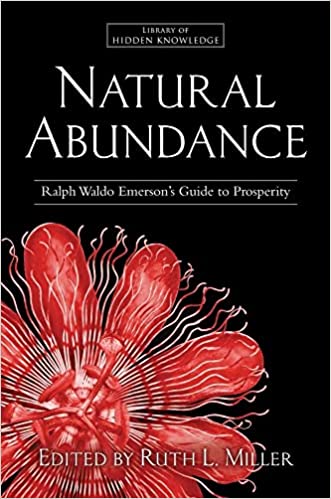
Suggested reading: Natural Abundance: Ralph Waldo Emerson’s Guide to Prosperity, edited by Ruth L Miller
 Krista Marson